
After the war: A Karoo economy that was always waiting
In a post-war or disrupted global economy, where supply chains falter and imported goods become unreliable, the Karoo does not need to reinvent self-reliance, but only to remember it.
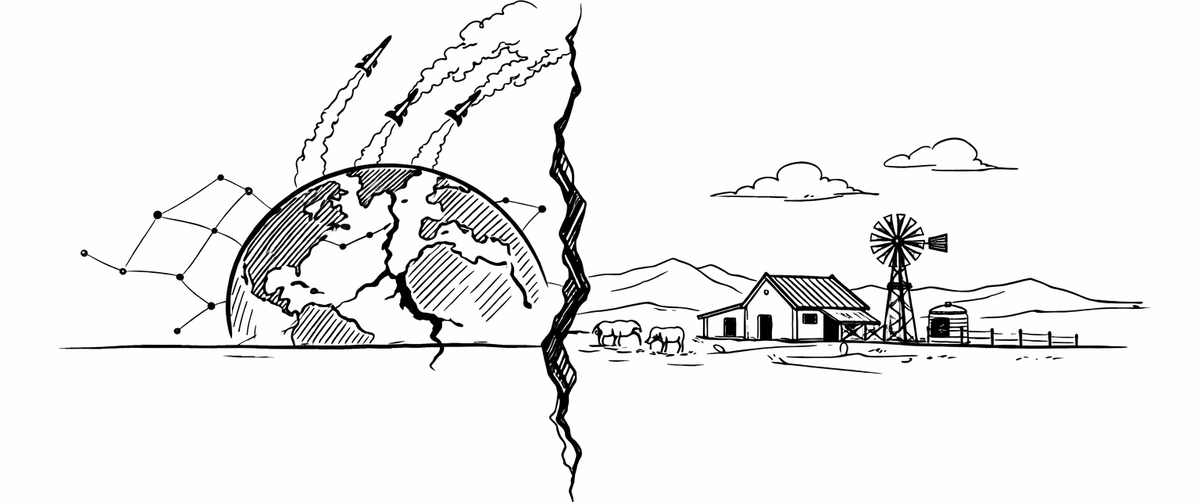
It's an uncomfortable thought: what happens to a place like the Karoo when the wider world explodes?

We experience disruption suddenly (a distant war, then a supply shock, then a breakdown in global trade) yet in regions like the Karoo collapse is contraction. Systems begin to falter at the edges: fuel becomes erratic, inputs expensive, deliveries slow, and almost imperceptibly, the distance between the Karoo and the global economy becomes even greater.
The question is whether that distance isn't a form of protection.
A region that knows how to contract
Long before global logistics stitched remote places into a single economic fabric, the Karoo functioned as a series of loosely connected micro-economies. Towns traded with farms, farms sustained households, and goods moved because they were necessary.
There is a tendency to romanticise this, to speak of self-sufficiency as though it were a virtue freely chosen. It was not - it was a condition imposed by the simple fact of being far from everything else; that condition left behind something useful. In a post-war or disrupted global economy, where supply chains falter and imported goods become unreliable, the Karoo does not need to reinvent self-reliance, but only to remember it.
The infrastructure may be modern, but the underlying logic is intact: produce what you can, trade what you must, waste little. While cities expand outward, dependent on invisible logistics networks, the Karoo has always had the instinct to draw inward when necessary.
The digital layer and its illusions
The Karoo is not the isolated place it once was. The region has become highly digitised, supporting remote workers and online stores and more. This creates the impression that the Karoo has stepped fully into the global system.
Every digital transaction relies on a chain of physical dependencies: electricity to power routers, diesel to run generators when the grid fails, transport networks to deliver hardware, global systems to maintain connectivity. When those systems begin to strain, the illusion of independence quickly fades.
A freelancer in Prince Albert may earn in dollars but still relies on a fuel truck arriving on time. A guesthouse may take bookings from Europe but still depends on a functioning travel economy and a steady supply of goods. The digital Karoo, for all its promise, is anchored firmly in physical reality.
When the global becomes unreliable
If global trade were to become erratic, the impact on the Karoo would be uneven pressure with a sprinkling of chaos. Fuel prices have already risen alongside fuel shortages, affecting everything from transport costs to food prices.
Imported goods might become scarce while agricultural inputs will become more expensive and take longer to arrive. Farms that once produced for export markets could start to look closer to home, or skip the middleman entirely to supply regional grocery stores using the farm-to-table model. Towns that relied on long supply chains might rediscover shorter ones. Informal trade (vegetables at a gate, meat sold between neighbours) becomes an opportunity.
A more local future by design or by default
There is a growing sense, even now, that hyper-local economies are inevitable in certain contexts, particularly as a hedge against global fragility.
A farmer diversifies not only for export but for local sale in a small town that supports a butcher, a baker, and a handful of growers. Skills that seemed outdated (repairing, preserving, building) regain their value.
At the same time, connectivity becomes a bridge that supports local trade. A producer might sell to a neighbouring town through a messaging app, or coordinate supply through simple online networks, while still operating within a largely physical economy.
What the Karoo already understands
Perhaps the most striking thing is that none of this is entirely new. The Karoo has always existed slightly out of step with the dominant economic pace. The region has known drought, isolation, and unpredictability. Its people have learned, often the hard way, that systems can fail.
Where urban economies optimise for efficiency, the Karoo has tended to favour durability. Where global systems prioritise speed, the region moves at a pace that allows for adjustment. These qualities can seem like limitations in a stable world, but in an unstable one they become advantages.
Not a retreat, but a reorientation
The question is not whether the Karoo can survive in a more local, self-reliant economy, but whether it will choose to lean into its self-reliance before it is forced to.
To speak of a post-war economy is to imagine a break: a before and an after. The global system, for all its reach, has always been based on something older and more grounded. When that base wears and fractures, what remains is a structure that has been there all along.
𝑊𝒊𝘵𝘩 𝘵𝙝𝙖𝗻𝑘𝘴 𝐟𝘰𝑟 𝑟𝙚𝐚𝒅𝒊𝑛𝙜,
𝘕𝘰🅼𝗶


Comments ()