
SALT telescope sheds new light on a star’s mysterious behaviour
While the Karoo’s horizons are prized for their natural beauty, they now also host a gateway to cosmic drama.

🔴 You might also like to read:
 Naomi Roebert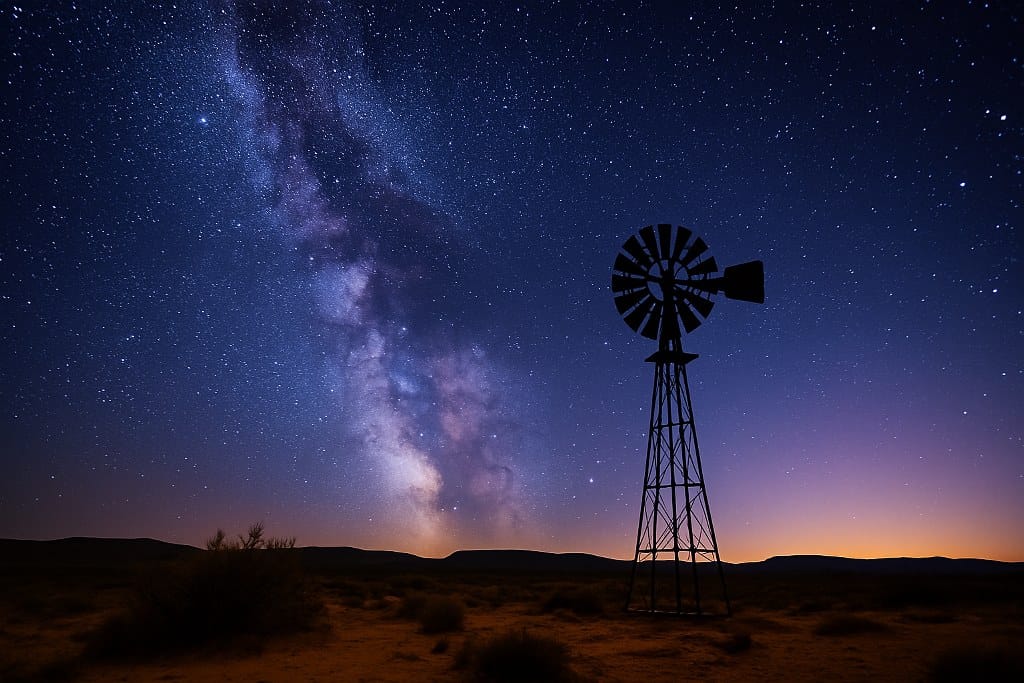
A scientific detective story has reached an exciting twist in the dark expanse above Sutherland. The Southern African Large Telescope, better known as SALT, played a central role in solving a puzzling cosmic mystery about one of the most remarkable stars in our galactic neighbourhood.
The story stretches from dusty Karoo plains to another galaxy to shed light on how local science can influence understanding of the wider universe.
Astronomers have long known that some stars live fast and die young, ending life in spectacular explosions called supernovae. One such star, WOH G64, had baffled observers.
Found in the Large Magellanic Cloud, a small companion galaxy to the Milky Way, this supergiant star had changed its behaviour in ways that didn’t make sense to scientists. It dimmed unexpectedly, its regular pulsations seemed to weaken and the light it emitted grew dominated by bright emission from ionised gas rather than the typical features of a cool star.
A puzzling giant in another galaxy
These odd shifts sparked theories that the star might be leaving its known phase and accelerating toward a rare, unstable state called a yellow hypergiant, a brief stage just before a supernova. Adding to the mystery, researchers identified a fresh shroud of dust around the star in 2024 that had made it even harder to read.
To unravel what was really happening, an international team of scientists turned to SALT, the largest optical telescope in the Southern Hemisphere. With its powerful spectrograph, SALT can dissect starlight into its constituent wavelengths and reveal details invisible to ordinary telescopes.
Researchers led by scientists from institutions in the United Kingdom and Chile observed the star over many months, collecting new spectra that offered clues hidden in the light itself.
Reading the fingerprints in starlight
Spectroscopy works like a stellar fingerprint. Instead of simply seeing how bright a star appears, astronomers examine specific lines in its light that correspond to chemical elements or molecular structures.
In this case, the team was searching for the telltale presence of molecules like titanium oxide (TiO), which form in the cool atmospheres of red supergiants. What they found changed everything.
The SALT data showed clear absorption bands from TiO, which can exist only if the star’s surface remains cool. In other words, despite its strange decline in brightness, WOH G64 is still a red supergiant and has not transitioned to a hotter state as previously believed.
That insight resolved a major piece of the puzzle. The star’s dimming and spectral oddities were not signs of a new evolutionary phase but the result of interaction with a smaller, hotter companion star.
🔴 You might also like to read:
 Naomi Roebert
Dust clouds and a hidden stellar partner
That companion star appears to be drawing material from the supergiant, stretching its extended outer layers and triggering periods of heavy mass loss that created dust clouds obscuring the view.
Meanwhile, radiation from the hot companion ionises the gas around them, producing the strange emission lines that had confused earlier observations.
SALT’s detailed spectral work was central to making this interpretation possible, offering a clearer picture of the dynamic interaction between the two stars.
For scientists, the discovery shows how complex the lives of massive stars can be, especially when they interact with companions. Understanding these processes helps astronomers refine models of stellar evolution and supernova precursors, which in turn affects how we interpret the life cycles of stars across the universe.
Why the finding matters for astronomy
SALT’s role underscores the telescope’s importance not just to South Africa but to global astronomy. Built as a flagship optical instrument in the remote Karoo, it combines a large collecting area with advanced instruments that make it possible to observe faint and distant objects with great precision.
This latest result adds to a long list of breakthroughs from SALT, from contributing to surveys of exotic stars to providing insights into galactic structure.
The success also shows the value of long-term observation campaigns. Monitoring a star over many months, rather than relying on isolated snapshots, can reveal changes that open new windows into stellar behaviour.
As a result, SALT continues to attract international research collaborations that use its capabilities to test theories and explore the universe in ways that would otherwise be impossible.
What it means for Sutherland and the Karoo
The story adds another layer to Sutherland’s identity as a centre for astronomy and scientific exploration. The town and its surroundings have become known not only for clear skies and stargazing tourists but also for real, cutting-edge contributions to humanity’s understanding of the cosmos.
While the Karoo’s horizons are prized for their natural beauty, they now also host a gateway to cosmic drama, where telescopes like SALT help humanity answer questions about stars far beyond our reach.
As this discovery shows, those answers can transform mystery into clarity while inspiring curiosity back on Earth.
🔴 You might also like to read:
 Naomi Roebert



Comments ()