
The hidden value of Karoo plant life
The Karoo's indigenous plants tell a story of ingenuity. From water-saving adaptations to traditional medicinal uses, this region offers powerful lessons for a changing world.
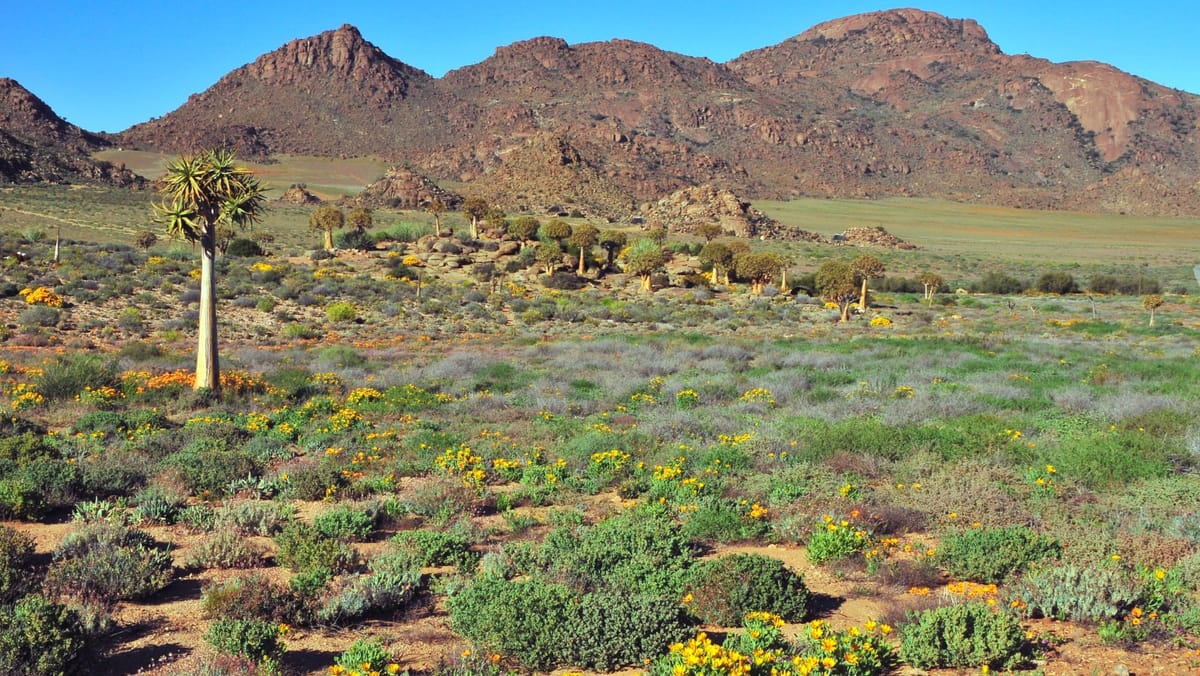
Beneath the Karoo's wide skies and across its stony plains, an intricate botanical world endures. Here, indigenous plants adapt, conserve, protect and respond, forming a living system that has evolved over millennia.
A life of scarcity
Rain in the Karoo is unpredictable and often disappears for long stretches. Plants have developed remarkable strategies in response. Many species grow low to the ground, reducing exposure to wind while conserving moisture close to the soil. Others, such as succulents, store water in thick leaves or stems, creating living reservoirs that sustain them through dry months.
The region forms part of the Succulent Karoo biome, one of the richest succulent regions on earth and a place where adaptation has become an art. Leaves shrink to spines, roots spread wide rather than deep, and growth cycles adjust to rainfall patterns. Some plants even remain dormant for years, waiting patiently for the right conditions before bursting into life. These responses form a system that maximises every drop of water while limiting loss at every stage.
Plants with purpose and use
The indigenous plants of the Karoo have long served practical purposes. Communities across the region have relied on these species for food and medicine, drawing on knowledge passed down through generations.
Spekboom and environmental restoration
Spekboom is one of the most widely recognised plants in the Karoo, valued for its restorative potential. It absorbs significant amounts of carbon dioxide while thriving in dry conditions, making it a powerful ally in land rehabilitation efforts. It also tastes surprisingly good as a chutney.
Cancer bush and immune support
Cancer bush, known locally for its long history in traditional medicine, has been used to support general wellness and immune function. It is often prepared as a tea or tonic, valued for its calming properties as well as its role in helping the body recover from illness.
Wild rosemary and respiratory relief
Wild rosemary has a subtle fragrance and is often used in remedies aimed at easing respiratory discomfort. Infusions made from its leaves are traditionally used to relieve coughs and colds, while its natural oils are believed to have soothing properties. Wild rosemary thrives in dry, open areas, offering support in a region where formal healthcare has not always been easily accessible.
Devil’s claw and anti-inflammatory properties
Devil’s claw is another notable plant, recognised for its use in managing pain and inflammation. Its roots have been harvested and prepared for generations, often used to ease joint discomfort and muscle strain. Today, devil's claw has gained international recognition, while its origins remain firmly tied to the arid regions of southern Africa, including the Karoo.
Aloe species and everyday healing
Various aloe species grow across the Karoo, each offering practical benefits. Their gel is widely used to treat burns and skin irritations, providing immediate relief in a region where exposure to sun and harsh conditions is part of daily life.
Soil binders and landscape stability: In addition to their medicinal uses, many Karoo plants play a vital role in maintaining the integrity of the land. Hardy shrubs and grasses anchor the soil, reducing erosion while improving water retention. This becomes especially important after rainfall, when the ground is vulnerable to being washed away.
The science behind adaptation
Many species use a process known as CAM photosynthesis, a method that allows them to open their pores at night rather than during the heat of the day. This reduces water loss while still enabling growth, a small adjustment with major impact.
Waxy coatings reflect sunlight while fine hairs trap moisture and muted colours reduce heat absorption. Even the shape of a plant can determine its survival, with rounded forms minimising exposure while channeling water towards the roots. These features show that adaptation in the Karoo is a collection of subtle adjustments. Each plant carries a blueprint made by generations of environmental pressure.
Indigenous plants in a changing climate
Droughts are intensifying in many parts of the world, while water scarcity is emerging as a defining challenge. In this context, drought resistant plants have become a critical area of study. Farmers and conservationists are turning to indigenous species as part of sustainable land management.
Spekboom restoration projects, for example, aim to rehabilitate degraded land while improving carbon capture. There is also growing interest in incorporating indigenous plants into gardens and urban spaces. These plants require less water and also support local biodiversity. Birds and insects depend on these species, creating ecosystems that extend beyond the wild Karoo into everyday environments.
A patient place: In understanding the indigenous plants of the Karoo, we begin to see that this barren region is finely tuned. These plants show how much can be achieved with less, provided there is patience and a deep connection to the land.


Comments ()