
Why old blankets, enamelware and riempie furniture endure
Practicality doesn't have to be the only defence of an old object. A blanket could matter because it covered several generations. An enamel basin recalls a grandmother’s kitchen, while the creak of a riempie chair can bring back a childhood room.
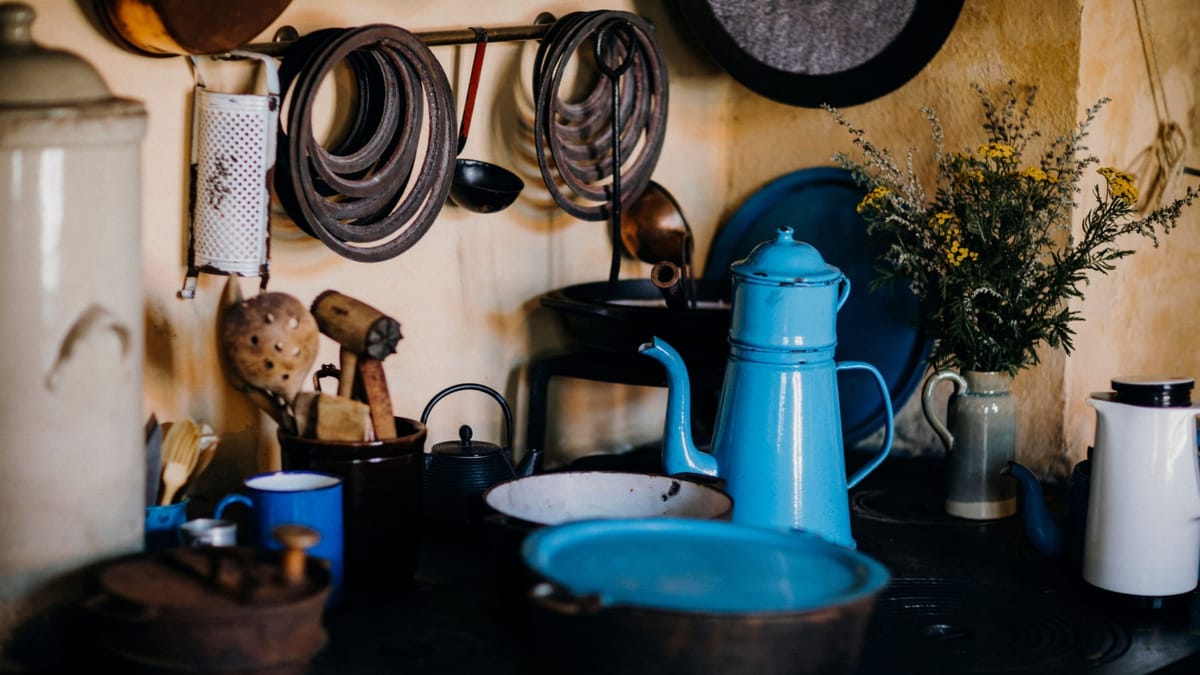
Certain objects are emblematic of the Karoo interior; a wool blanket folded at the foot of the bed or a blue-and-white enamel basin at the washstand in the adject bathroom. A riempie chair pushed beneath a heavy wooden table in the guest cottage of your farm stay.
Some of these objects are used because they still perform their original jobs well. Others survive because they remind us of a less hurried domestic life. Often, nostalgia and use are woven together so tightly that it's difficult to separate them.
The real test is simple: would we still use these objects if they didn't look old?
The blanket that still earns its place
Of the three, a good wool blanket has the strongest practical claim. Karoo winters can be bitter, especially in homes with high ceilings and limited heating.
Wool’s usefulness comes from the structure of the fibre. Merino wool regulates temperature and recovers its shape after being stretched. An old pure-wool blanket that has been stored properly will still be warm and useful. One weakened by moths or years of rough washing might survive only because nobody wants to throw away something that belonged to the family.
The newer blanket bought in “heritage” colours can look convincingly old while containing a high proportion of synthetic fibre. Such a blanket is still useful, although its value comes partly from the mood it creates rather than an unbroken connection with the past.
South Africa’s blanket tradition is also broader than farmhouse décor. The Karoo Winter Wool Festival’s account of regional wool traces the arrival of Merino sheep in the Greater Karoo to the late 18th century. A blanket made from strong natural fibre is therefore a working object linked to the region’s farming history.
Enamelware was made for hard use
Enamelware also began as a practical answer to an everyday problem. These dishes combine a metal body with a glass-like coating fused to the surface under intense heat. This creates a smooth layer that resists stains and makes it relatively easy to clean.
Vintage enamelware was suited to farmhouses and outdoor cooking where objects had to withstand daily knocks. A basin could wash vegetables in the morning and clothes later in the day. A mug could travel from the kitchen to the veld without much ceremony.
The weakness appears once the coating chips. Exposed metal can rust, while badly cracked or unknown antique pieces are not automatically suitable for food preparation. A heavily worn bowl holding dried flowers on a guesthouse table has entered a different category.
There's nothing wrong with that. Problems arise only when decoration is marketed as old-fashioned practicality. A deliberately distressed bread bin labelled “BREAD” may look at home in a country kitchen, but a sealed modern container will protect the loaf far more effectively.
Riempie furniture grew from adaptation
Riempie furniture probably has the most distinctive South African identity. The name comes from the narrow leather or rawhide strips woven to form the seat or back of a chair or bench. The design was an adaptation. Woven rawhide was used at the Cape in place of rattan, which was widely available in Batavia, Indonesia. Livestock farming made hides a more accessible local material.
This was practical design in its clearest form. The woven seat needed less solid timber and could be repaired without replacing the entire chair. When the strips loosened or broke, a skilled craftsperson could weave new ones through the existing frame.
A genuine riempie chair with a stable frame and properly tensioned strips is useful furniture. A reproduction made from weak timber or imitation strapping might offer little more than the outline of tradition.
Nostalgia is useful too
Practicality doesn't have to be the only defence of an old object. A blanket could matter because it covered several generations. An enamel basin recalls a grandmother’s kitchen, while the creak of a riempie chair can bring back a childhood room.
Nostalgia becomes misleading only when it erases the harder side of earlier domestic life. Enamel basins were used because many homes lacked modern plumbing. Blankets were vital because heating was limited. Furniture was repaired repeatedly because replacement could be difficult or expensive.
Their endurance indicates something more interesting than “old things were better”. The best of them were repairable and made from materials suited to their surroundings, which is why some old Karoo household objects still work. Others simply style a modern room. The lasting pieces often do both.
 Lynette Spencer
 Mariana Balt
 Liz Thorne
 Anchen Coetzee





Comments ()