
The lesson is easy to miss because biocrusts are so small. We notice a damaged shrub or a deep vehicle rut. We are less likely to notice the thin living layer between them, or recognise a pale, bare patch as something that used to be there.
A patch of Karoo ground, inspected closely, can have a dark surface, lightly speckled with tiny growths. What appears to be a skin on the soil is often a community of living organisms: bacteria, lichens, mosses and other microscopic life growing together in its uppermost layer.
Scientists call these communities biological soil crusts, or biocrusts. They are especially important in dry country, where plants don't cover every part of the ground. In the Succulent Karoo near Soebatsfontein, researchers have studied crusts in the open spaces between shrubs as well as beneath them. At their study site, biocrusts covered up to a third of the area.
A living layer, not a hard shell
Biocrust is a collective name, not a single organism. One patch could be dominated by cyanobacteria, another by lichens and another by moss. Each also supports other microbes. Researchers in the Succulent Karoo found that these different crust types harbour distinct microbial communities and respond differently to conditions like moisture and temperature.
Cyanobacteria are good at making a start on exposed soil, and their growth binds loose particles together. Over time, as other organisms become established, a more varied surface is established. These crusts photosynthesise when conditions allow and take part in the cycling of carbon and nutrients. They are living components of the veld, even when a dry spell makes them appear inactive.
A shrub’s roots hold soil around the plant, but a biocrust stabilises the spaces between the shrubs. If that surface breaks and loose particles are exposed, wind and running water have more opportunity to carry soil away. Replacing lost topsoil is no quick task in an arid region.
What happens under a wheel or hoof?
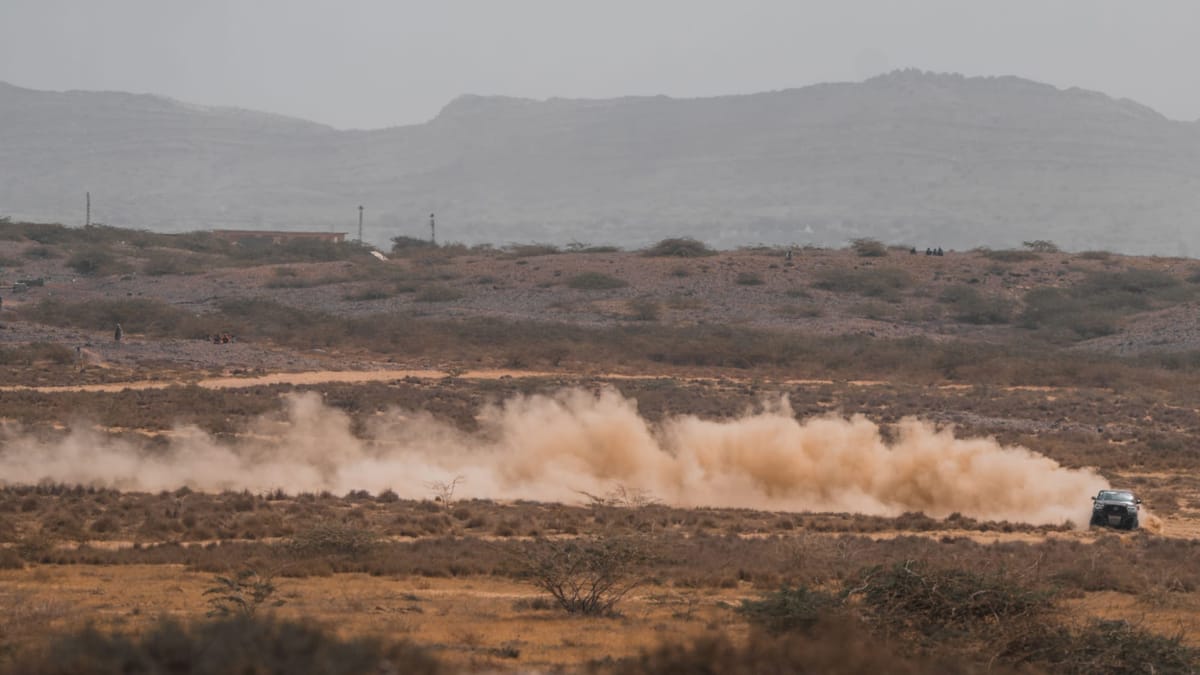
A vehicle tyre cuts into and compresses the surface. Hooves can repeatedly break the surface along routes to water or resting places. The effect depends on the type of crust as well as the force of the disturbance and how often it happens. A single crossing and a regularly used track don't leave the same legacy.
The most immediate change is physical: the continuous living surface becomes fragments or bare soil. Research on dryland biocrusts has found that trampling well-developed crust can increase runoff and sediment loss compared with undisturbed ground. Studies in the Succulent Karoo have also linked heavy grazing pressure to a shift away from richer moss and liverwort crusts towards simpler crusts or damaged soil surfaces.
There can be wider changes too. A regional study of southern African biocrusts found that livestock trampling affected their cover and composition, adding to pressures associated with changing climate conditions. But the effect of a crust on how much rain soaks into the ground is not identical everywhere. Soil texture and the kind of crust are factors. It would be misleading to claim that every broken patch produces the same amount of runoff.
Can the crust grow back?
In an experiment in the Succulent Karoo, researchers deliberately removed small patches of crust and watched what followed. Cover began to return relatively quickly, along with some soil-stabilising function. But the returning crust was dominated by early-stage organisms and still differed from undisturbed patches.
Full recovery from the severe disturbance took longer than the study’s three years. The researchers also stressed that removing a crust experimentally is not the same as grazing or trampling it.
This is why the question focuses on repeated damage. A crust can begin to repair itself between disturbances. If tyres or hooves keep crossing the same patch, that developing layer is broken again.
Managing where traffic and livestock concentrate can leave other areas time to recover. The Succulent Karoo experiment suggests that moderate grazing at suitable times can coexist with biocrust development; the presence of animals doesn't mean the living surface has to be lost.
The lesson is easy to miss because biocrusts are so small. We notice a damaged shrub or a deep vehicle rut. We are less likely to notice the thin living layer between them, or recognise a pale, bare patch as something that used to be there.
Next time you find yourself strolling through the veld, look at the ground between the plants. Some of its life is no taller than a few millimetres, but these organisms affect what happens to the soil when wind blows or rain falls and the veld is used.
 Liz Thorne
 Lynette Spencer
 Mariana Balt

Comments ()